An Interview and Photoshoot with Deryn B
Deryn is a professional ballet dancer and model based in the Southwestern region of the United States.
Today we’re featuring some of my favorite photos we’ve crafted together, along with an interview with her. (The interview is part of my “Open Hearts, Adaptive Minds” series)
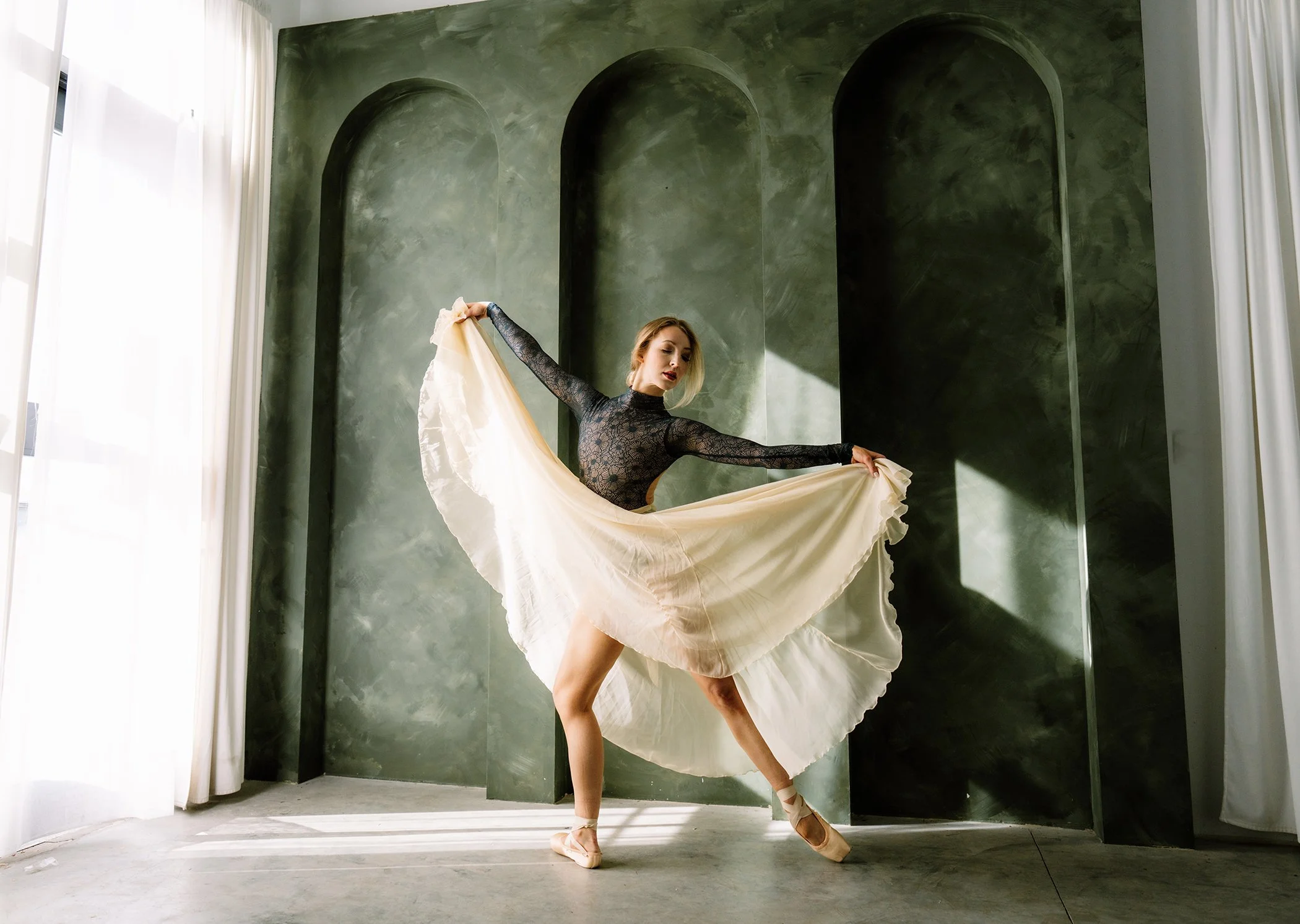
An Interview and Photoshoot with Deryn B
How do you feel you’ve changed as an artist over the course of your career so far?
“Changes in me as an artist have always coincided with changes in me as a human being. My relationship with myself has, in many ways, dictated what I was able to access as a dancer.
I wish I had understood that ten years ago—that allowing myself to be something great isn't about becoming something I'm not. It's about allowing myself access to something that already exists inside me. Giving myself permission to believe in my own goodness. It’s as if I am terrified to find out that it isn’t there and yet I will readily believe everyone else has it.
For a long time, the loop in my head was that I needed to apologize for existing. If I did something well, it wasn't really me, it was luck, or somehow, I had gotten away with something. As if I had stolen something from someone else. I think I had a real fear of succeeding, and honestly, even calling it that is still a little scary.
But eventually I had to ask myself: who the hell do I think I am not to give everything I have to this work? What right do I have to gatekeep anything?
And even as I say that, there's still a part of me that goes, “Well, maybe they're not that great...” There I go again.
I don't think this is a process that ever really ends, and maybe that's part of the point. Life keeps moving, and so do we. Dance is movement, but even stillness is movement. Presence is movement. I've always been fascinated by the idea that nothing exists without consequence; that even something as small as an exhale creates a ripple beyond itself.
I think, if I'm honest, the fear of giving myself permission has been one of the greatest barriers in my artistic life. And maybe one of the biggest changes in me as an artist is that I am finally starting to remove that barrier.
I don't think I've finished the process. I think I've only just started.”
Do you think it’s important to have hobbies and passions outside of dance?
“Absolutely, and yet, I think it’s tricky. Dance is an all-consuming art form. Even doing it more or less part-time, it takes an enormous amount of time and recovery, especially as I’ve gotten older. You have to choose it, which means you inevitably sacrifice other things. As a juxtaposition, I think having a hobby outside of dance, helps the dancer.
I was a horse girl as a kid and did equitation shows. I actually started dancing because my best friend at the time was taking jazz classes and I wanted to be like her. A couple of years later, it became apparent that dancing was something I needed to take more seriously, so the horseback riding lessons stopped and I went to a proper ballet school.
I never stopped loving horses, though. I came back to them years later, after moving to New Mexico. I got involved with riding again and eventually worked as a professional wrangler at a horse rescue. It was such a healing experience. Learning to trust a 1,200-pound, incredibly agile animal taught me a lot about trusting myself as a mover. Eventually I decided to dance again, and I was incredibly lucky to be invited to join NMBC after a seven-year hiatus from full-time ballet.
I kept riding and working at the rescue for a couple of years, but once again, I had to choose. Dance is so temporary, and I felt incredibly lucky that I could still do it. Riding while I was also doing Nutcracker rehearsals started giving me an anxiety I didn’t want. I was already more cautious than the other wranglers, and as I started to really cherish my instrument, I became less willing to take the risk of another fall or injury. Horses became more of a hobby again, but I know I can return to them when I’m ready.
I think one thing that people outside of professional dance don’t always understand is that once you’ve performed at this level, dance can never quite be a hobby in the same way. When you’ve experienced that feeling of peak athleticism: when a pirouette sails around, or you find that moment of weightlessness in a balance where your body is perfectly stacked, or you feel like you’re flying at the height of a saut de chat, it’s hard to accept anything less.
Maybe I still have something to learn there: patience and forgiveness with my body and with the things I can no longer do. But right now, I know I don’t want anything less from dance.
And that’s part of why I think having something outside of it is so important. A hobby gives you a place to recuperate in a way that PT and sleep can’t. It’s a space where that constant demand to be better, stronger, more precise, more disciplined doesn’t exist. You can just love something.
I feel very lucky that I got to know horses that way. And I think having something I love that isn’t dance has ultimately made my relationship with dance richer.”
What is something you’ve learned that helped you become a more fulfilled artist that also helped you live a better life?
“I think one of the biggest things I’ve learned is that art is really about giving.
Even if all I’m giving is a feeling of glee to a young dancer during her first Nutcracker, I love that. There’s something incredibly meaningful about realizing that what you’re doing can create a feeling in someone else that they carry with them.
I think the more we give to other people, the more we give to ourselves. For a long time, I was very focused on what I was supposed to achieve as a dancer—what I could do, how well I could do it, whether I was good enough. I think I understand now that the most fulfilling part is much less about proving something and much more about what I can give.
I don’t want to sound like I’ve perfected this or that I live by it all the time. I absolutely don’t. But I’m really grateful that I can see it now. It took me a long time to get here, and there’s something about realizing that this is real that feels like such a relief.”
The world often teaches us to close our hearts, what’s a lesson you’ve learned in how to keep your heart open?
“My body doesn’t really give me a choice. If I want to dance, I have to open my heart to my body.
Unfortunately, I think a lot of dance environments teach us from a young age to reject ourselves. When we do something well, the response is often, “Okay, now do it even better.” I was taught to reject myself, and for a long time I thought I had to hate myself in order to improve. But when I hate myself, I can’t really love other people very well either.
I’ve started to realize that when we close our hearts to other people, we’re often closing them to ourselves too. If I find myself becoming unforgiving, I try to recognize that the rejection is actually a sword I’m holding over my own head.
I’m certainly not evolved enough to claim I’ve perfected this. I know I never will. But I hope I’ll keep practicing. Empathy is a practice, like pirouettes. Some days are better than others, and sometimes you don’t even know why. You just keep practicing.
The greatest gift I’ve given myself is allowing other people to be imperfect. I think that has allowed me to be more forgiving of myself, too.
There’s a quote by Andrea Gibson that says, “Let your heart break so your spirit doesn’t.” That idea has stayed with me because, as terrifying as it is, I think it’s important to let your heart remain capable of breaking. Hearts do mend. I’ve had my heart destroyed in ways that made me wonder if it could ever open again, but somehow my spirit remained. Maybe spirit is just another name for an open heart.
I’m still only scratching the surface of that. What do I know?”
What is something you do to help other people and the planet thrive?
“Teaching.
I sort of fell into teaching in my mid-twenties because it was just what dancers did. I also wanted to cross-train, but I couldn’t afford all the expensive classes in New York City. So, in a way, I started teaching for selfish reasons. And then it evolved into something really beautiful.
I get to help people. I get to teach people about how their bodies work and how to take care of them. What started out as something fairly bougie, where I was helping people get six-pack abs, turned into helping people learn to walk safely again, helping young dancers build strength and stability so they don’t get injured, helping someone with multiple spinal fusions rediscover his core after years of immobility, and helping people who have experienced trauma feel safe in their bodies again through movement.
I think there’s a stigma toward dancers that is actually connected to how we value bodies and movement in our culture. Body intelligence is incredibly important for feeling safe in your own body. It isn’t just about confidence or appearance. It’s about freedom.
As someone who has been tremendously active my entire life, I’ve also had to learn what movement feels like in a body that doesn’t have the same physical capacity mine does. That has forced me to develop a lot more sensitivity and empathy as a teacher. I’ve had to understand why someone might not even be able to feel or conceptualize a movement that seems completely obvious to me.
And I’ve come to believe that if I can’t break something down to its barest form and make even the most inexperienced mover understand it, then I probably don’t fully understand it myself. There’s a principle often associated with the physicist Richard Feynman: if you can’t explain something simply, you don’t understand it well enough.”
Got a favorite quote?
“This is a tough one. There are so many but I love this line from an Andrea Gibson Poem called “What Can’t Be Taken”
“Healing was learning
No one has ever laid a fingerprint
On the part of me that’s infinite.”
I have felt like I’ve lost everything before, even if I didn’t, and learned that this is true and I think that’s something that could keep anyone from giving up.”
Keep an eye on the Zine for future interviews and photoshoots with Deryn.
Till next time,
-Oliver Endahl